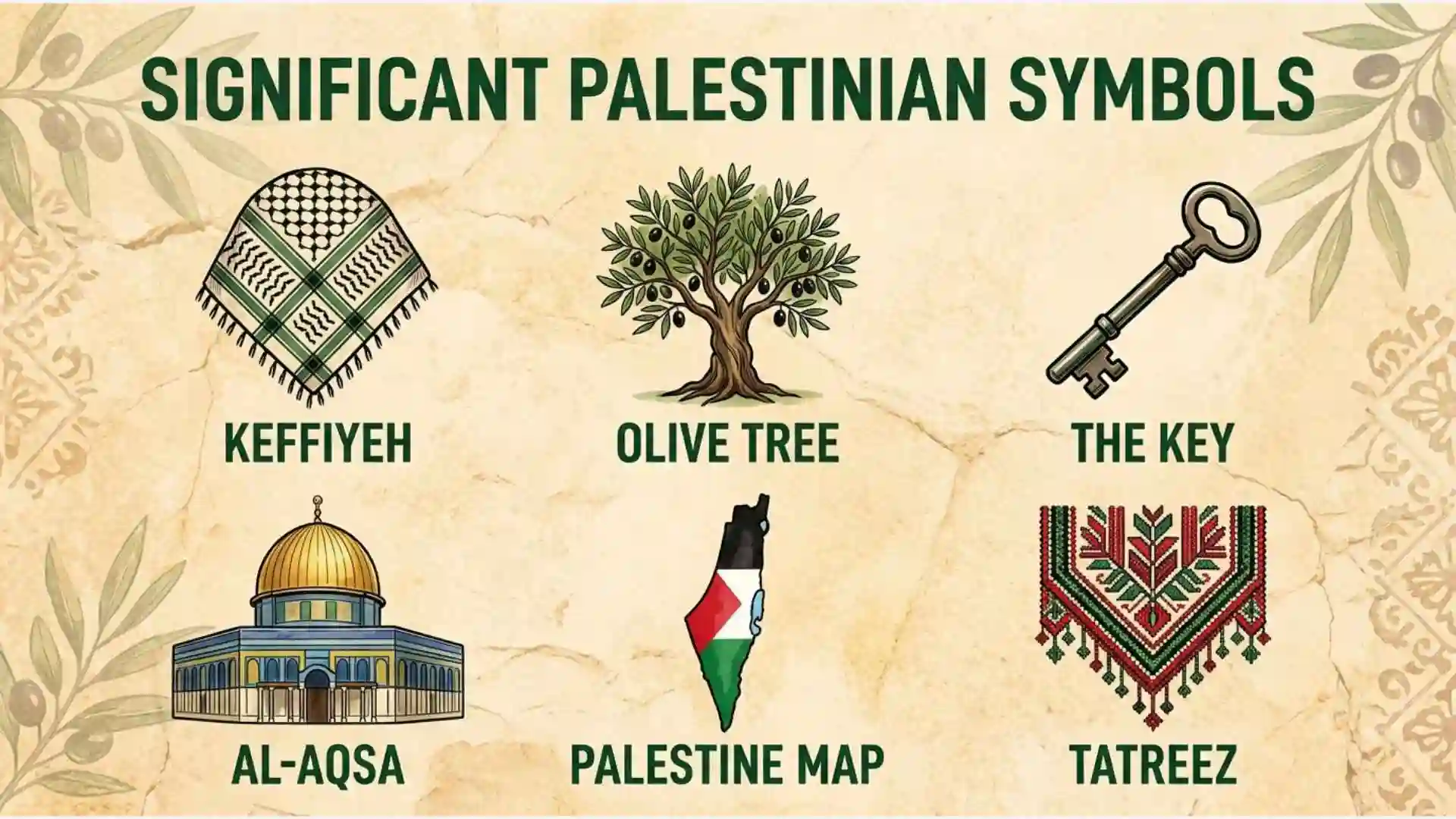
Palestinian symbols express identity, heritage, memory, attachment to the land, and hopes for freedom and return. Some, such as the Palestinian flag and traditional keffiyeh, are recognized around the world.
Others, including embroidered tatreez patterns, old house keys, olive trees, oranges, poppies, and the cartoon figure Handala, carry meanings rooted in family histories and particular regions.
You may encounter these symbols on clothing, flags, artwork, jewelry, murals, protest signs, social media posts, museum objects, and traditional Palestinian dresses. Understanding them requires more than assigning each image a simple definition. Their meanings developed through agriculture, village life, displacement, political movements, art, and the preservation of cultural traditions.
Quick Meaning of Palestinian Symbols
Palestinian symbols represent national identity, cultural continuity, connection to the land, collective memory, resilience, displacement, and the desire for freedom or return. Major examples include the Palestinian flag, keffiyeh, olive tree, key, map of historic Palestine, tatreez embroidery, Handala, Jaffa orange, cactus, poppy, and traditional thobe.
Palestinian Symbols Overview Table
| Symbol | Primary Meaning | Historical or Cultural Origin | Common Modern Use |
| Palestinian flag | National identity and unity | Derived from the flag of the 1916 Arab Revolt | Government buildings, public events, protests, clothing, art |
| Black-and-white keffiyeh | Rural heritage, identity, solidarity, resistance | Traditional regional head covering | Scarves, fashion, political gatherings, cultural celebrations |
| Olive tree or branch | Roots, endurance, peace, land, livelihood | Ancient Mediterranean agriculture | Art, logos, poetry, jewelry, posters |
| Key | Displacement, memory, home, right of return | Keys kept by Palestinian families displaced in 1948 | Necklaces, murals, demonstrations, family keepsakes |
| Tatreez embroidery | Heritage, regional identity, women’s knowledge | Traditional village embroidery | Thobes, bags, cushions, contemporary fashion |
| Handala | Exile, defiance, conscience, unfinished return | Created by cartoonist Naji al-Ali | Graffiti, posters, tattoos, political cartoons |
| Map of historic Palestine | Homeland, geography, national memory | Modern national imagery | Jewelry, maps, posters, clothing |
| Jaffa orange | Coastal Palestine, agriculture, prosperity, memory | Citrus-growing communities around Jaffa | Literature, paintings, posters, branding |
| Cactus or sabr | Patience, survival, endurance, remaining on the land | Native and cultivated landscape imagery | Art, photography, poetry, memorial imagery |
| Palestinian thobe | Community, femininity, local history, craftsmanship | Village dress traditions | Weddings, festivals, museums, cultural events |
| Poppy or anemone | Land, sacrifice, beauty, renewal | Wildflowers native to the region | Paintings, embroidery, posters |
| Dome of the Rock | Jerusalem, faith, history, national attachment | Islamic sacred architecture in Jerusalem | Posters, photographs, religious and national artwork |
What Do Palestinian Symbols Mean?
Palestinian symbols communicate several connected ideas rather than one fixed message. Their central theme is continuity: the belief that a people, culture, and relationship with a homeland can remain alive despite migration, displacement, conflict, or political change.
The flag represents collective national identity. The key recalls homes and communities from which families were displaced. The olive tree represents both physical rootedness and the ability to survive harsh conditions. Tatreez preserves knowledge passed from one generation of women to another. The keffiyeh links rural history with modern Palestinian identity.
These symbols may also express grief, protest, solidarity, faith, cultural pride, or hope. Meaning depends on where the image appears and who uses it. A keffiyeh worn at a wedding may emphasize heritage, while the same scarf at a demonstration may communicate political solidarity.
Palestinian symbols should therefore be interpreted in context. They are not interchangeable, and not every Palestinian assigns exactly the same meaning to each one.
History and Origin of Palestinian Symbols
Palestinian symbolism developed from several historical layers: ancient agriculture, religious traditions, village customs, Arab cultural identity, modern nationalism, displacement, and contemporary visual art.
Agricultural and Village Origins
Many Palestinian symbols come from daily life rather than formal political movements. Olive trees, wheat, grapes, figs, citrus fruit, cypress trees, birds, and flowers appeared in farming traditions, songs, textiles, household objects, and local storytelling.
Traditional embroidered dresses also reflected village identity. Patterns, colors, materials, and styles could indicate a woman’s home region, community, social position, or stage of life. Palestinian embroidery was added to UNESCO’s Representative List of the Intangible Cultural Heritage of Humanity in 2021. UNESCO describes it as an intergenerational practice featuring geometric designs and motifs such as birds, trees, and flowers.
The Growth of National Symbols
During the twentieth century, older cultural objects gained additional national meanings. Clothing, farming tools, regional plants, folk dances, and embroidery increasingly represented the Palestinian people as a whole.
The Palestinian flag is based on the colors and design associated with the 1916 Arab Revolt. Palestinian national leaders adopted a related flag during the early twentieth century, and the design later became the official flag of Palestinian national institutions.
Symbolism After 1948
The mass displacement of Palestinians during the 1948 Arab-Israeli war, known to Palestinians as the Nakba, transformed familiar household objects into powerful symbols of memory.
Keys became especially important because some displaced families preserved the keys to houses they had left behind. These objects were passed to children and grandchildren as evidence of former homes and as symbols of hoped-for return. Reuters has documented how original and symbolic keys continue to appear in Palestinian family histories and public commemorations.
Over time, the village house, doorway, family photograph, cactus hedge, abandoned well, and orange grove also came to represent lost or remembered places.
Symbolism and Interpretation
Identity and Belonging
Palestinian symbols allow people to express belonging even when they live outside the region. A thobe, embroidered pendant, flag, or keffiyeh can connect members of the diaspora to family traditions and places they may know through stories rather than personal experience.
Resilience and Survival
The olive tree and cactus are commonly interpreted as signs of endurance. Both can survive difficult environmental conditions. Their deep roots and ability to regrow make them natural metaphors for a people maintaining identity through hardship.
Memory and Loss
Keys, old photographs, village maps, house doors, and place names often symbolize personal or inherited memory. Their meaning is not only political. They may represent grandparents, childhood, family property, community life, or a vanished neighborhood.
Hope and Freedom
Birds, open doors, sunrise imagery, flags, and raised hands can express hope, liberation, or a future free from violence and restriction. The dove may represent peace, although its interpretation depends heavily on the artwork.
Negative or Painful Meanings
Some Palestinian symbols are connected with trauma, mourning, imprisonment, war, and forced displacement. Barbed wire, prison bars, demolished homes, broken keys, and blood-red flowers can communicate suffering or loss.
These meanings should not be generalized to every use. A red poppy, for example, may simply represent the natural landscape in one artwork but sacrifice or remembrance in another.
Cultural Significance of Major Palestinian Symbols
The Palestinian Flag
The Palestinian flag contains black, white, and green horizontal bands with a red triangle at the hoist. Its colors belong to the broader Pan-Arab tradition and are historically connected with several Arab dynasties and nationalist movements.
Today, the flag represents Palestinian national identity, political aspirations, unity, and international solidarity. It appears at official institutions, cultural festivals, sporting events, demonstrations, homes, and diaspora gatherings.
Individual interpretations of the colors vary. Popular explanations often associate black with hardship, white with peace, green with the land or hope, and red with sacrifice. However, these modern explanations should not be confused with the flag’s documented historical development from Pan-Arab colors.
The Keffiyeh
The keffiyeh is a square head covering traditionally worn in parts of the Arab world. In Palestine, the black-and-white version became particularly associated with rural society and later with Palestinian nationalism.
The British Museum notes that black-and-white checked keffiyehs became symbols of Palestinian nationalism during the twentieth century. Yasser Arafat’s frequent use of the scarf further strengthened its global association with Palestinian identity.
Modern claims that every line in the keffiyeh pattern has one ancient, fixed meaning should be treated carefully. Fishnet, olive-leaf, and trade-route interpretations are popular today, but textile historians note that historical keffiyehs appeared in various patterns and colors.
The Olive Tree
The olive tree represents connection to the land, family inheritance, agricultural livelihood, patience, peace, and endurance. Olive cultivation has shaped the food, economy, landscape, and seasonal traditions of the eastern Mediterranean for thousands of years.
For Palestinian families, an individual tree may also have personal value. It can mark inherited property, a grandparent’s labor, an annual harvest, or a relationship with a particular village.
The olive branch’s international association with peace adds another layer of meaning. In Palestinian art, the tree can therefore symbolize both rootedness and the hope for peace.
The Key of Return
The Palestinian key commonly symbolizes homes lost through displacement, especially during the Nakba. Families who retained original house keys often preserved them as heirlooms.
In public art, the key may be enlarged, combined with a map, or designed with the word “return.” It represents memory, property, continuity between generations, and the Palestinian claim to a right of return.
Not every displayed key is an original house key. Many are modern artistic representations, but their symbolism comes from authentic family experiences of preserving keys after displacement.
Tatreez Embroidery
Tatreez is traditional Palestinian embroidery, especially associated with women’s clothing. It often uses cross-stitch designs arranged in geometric bands or panels.
Patterns historically varied among regions and communities. Dresses from Bethlehem, Ramallah, Hebron, Gaza, Jaffa, and other areas could differ in fabric, color, cut, and embroidery.
Tatreez symbolizes women’s creativity, family knowledge, regional heritage, patience, and cultural survival. Today, it appears on traditional thobes as well as jackets, handbags, shoes, cushions, wall art, and jewelry. The Metropolitan Museum of Art describes tatreez as a cultural practice through which Palestinian women and girls decorated garments with meaningful motifs.
Handala
Handala is a barefoot Palestinian boy created by political cartoonist Naji al-Ali. The character usually appears with his back turned and his hands clasped behind him.
Handala represents exile, poverty, defiance, moral witness, and refusal to accept unjust solutions. The character is traditionally described as ten years old, the age at which al-Ali was displaced from Palestine. He does not grow older because his return remains unfinished.
Handala first appeared in 1969, while the familiar back-facing form developed in the early 1970s. He has since become one of the most recognizable figures in Palestinian political art.
The Jaffa Orange
The Jaffa orange represents coastal Palestine, especially the historic citrus industry around Jaffa. Before 1948, oranges from the area were internationally known and economically important.
In Palestinian literature and visual art, the orange can evoke prosperity, family orchards, Mediterranean life, displacement, and nostalgia. It differs from the olive tree because it is more strongly associated with coastal cities and citrus-growing areas.
The Cactus
The cactus, often called sabr in Arabic, carries a useful linguistic connection. The Arabic root is also associated with patience and steadfast endurance.
Cactus hedges once marked boundaries around homes, fields, and villages. Because the plants could remain after buildings disappeared, artists and writers used them to symbolize memory, survival, and the continued presence of a place.
The Map of Historic Palestine
The outline map of historic Palestine is widely used in necklaces, posters, embroidery, paintings, stickers, and online graphics.
It may represent homeland, geographic memory, national unity, or attachment to cities and villages across the region. Because borders and sovereignty are central political disputes, the map can also carry strong political meaning. Its interpretation depends on the design, wording, and context in which it appears.
Religious and Spiritual Meaning
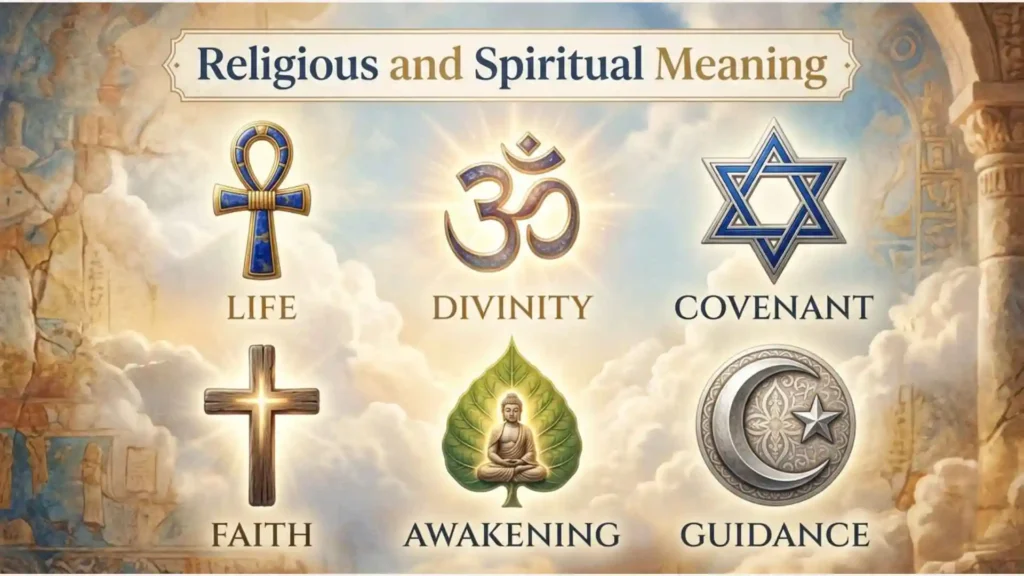
Palestinian identity includes Muslim, Christian, Samaritan, Druze, secular, and other experiences. Therefore, no single religious symbol represents all Palestinians.
The Dome of the Rock and Al-Aqsa Mosque
Images of the Dome of the Rock’s golden dome and the Al-Aqsa Mosque compound symbolize Jerusalem, Islamic faith, sacred history, and Palestinian attachment to the city.
The site is known to Muslims as al-Haram al-Sharif and is one of Islam’s holiest places. In Palestinian posters, the golden dome often functions as both a religious image and a national symbol of Jerusalem.
The Church of the Holy Sepulchre
For Palestinian Christians, the Church of the Holy Sepulchre represents the crucifixion, burial, and resurrection traditions associated with Jesus. It also symbolizes the long history of Arab Christian communities in Jerusalem.
The Cross and Crescent Together
Artists sometimes display a Christian cross beside an Islamic crescent. This pairing usually represents Muslim-Christian unity within Palestinian society rather than a new religious emblem.
Sacred Plants and Foods
Olives, dates, figs, wheat, grapes, and pomegranates hold significance in the religious texts and traditions of the region. In Palestinian culture, their spiritual associations may overlap with agricultural, family, and national meanings.
Where Palestinian Symbols Are Used
Palestinian symbols appear across both traditional and contemporary settings:
Clothing and Textiles
Thobes, keffiyehs, embroidered jackets, scarves, graduation stoles, and modern fashion frequently feature the flag colors, map outlines, or tatreez patterns.
Jewelry
Popular designs include key pendants, map necklaces, olive branches, Handala figures, flag-colored beads, and miniature embroidery patterns.
Art and Literature
Palestinian artists and writers use oranges, birds, olive groves, keys, village houses, sea imagery, and maps to explore belonging, exile, resistance, and memory.
Murals and Posters
Public murals often combine multiple symbols, such as Handala standing beside an olive tree or a key shaped like the map of Palestine. The Palestinian Museum identifies the map, olive, orange, keffiyeh, key, embroidery, birds, anemones, and traditional dress among recurring images in Palestinian poster art.
Weddings and Cultural Festivals
Traditional dresses, embroidery, folk songs, dabke dancing, flags, and regional foods celebrate family heritage and community identity.
Demonstrations and Solidarity Events
Flags, keffiyehs, keys, watermelons, olive branches, and protest signs are often used to express political positions or solidarity with Palestinians.
Tattoos and Digital Media
Handala, keys, maps, Arabic calligraphy, olive branches, and flag colors appear in tattoos, profile images, hashtags, digital illustrations, and social media graphics.
Common Variations and Modern Adaptations
Watermelon Imagery
The watermelon has red flesh, green skin, white rind, and black seeds, matching the colors of the Palestinian flag. It became a popular visual substitute or companion for the flag in political art.
Today, the watermelon appears in posters, pins, clothing, emojis, and social media posts. Its meaning depends on context because a watermelon image can also be purely decorative.
Tatreez Combined with Modern Objects
Artists now apply traditional embroidery patterns to sneakers, laptop cases, denim jackets, phone covers, and digital designs. This adaptation allows cultural motifs to travel beyond traditional clothing.
The Key Combined with a Map
Modern jewelry and poster designs often place a map inside the head of a key. This combines the ideas of homeland, lost homes, return, and inherited memory.
Olive Trees with Human Features
Artists may shape olive roots into hands, faces, or human bodies. Such designs emphasize the connection between people and land.
Flag-Colored Calligraphy
Arabic words such as Filastin, meaning Palestine, may be written in black, white, green, and red. Calligraphy sometimes forms the shape of a bird, key, heart, or map.
Common Misconceptions About Palestinian Symbols
“Every Palestinian Symbol Is Ancient”
Many symbols have old cultural roots, but their modern national meanings developed mainly during the nineteenth and twentieth centuries. The key and Handala, for example, gained their present significance through modern experiences of displacement and political art.
“Every Keffiyeh Pattern Has a Proven Ancient Meaning”
Popular guides often claim that each line represents fishing nets, olive leaves, or trade routes. These interpretations are meaningful today, but historians have not established one universal symbolic code for every historical keffiyeh.
“Tatreez Is One Single Pattern”
Tatreez includes many motifs, regional styles, colors, materials, and garment traditions. Treating it as one standardized design erases local variation.
“The Flag Colors Have Only One Meaning”
The colors belong to the Pan-Arab tradition and have historical associations with Arab dynasties and movements. Modern emotional meanings exist, but no single color explanation covers every period or interpretation.
“All Palestinian Symbols Are Religious”
Many are cultural, agricultural, national, artistic, or familial. The key, keffiyeh, thobe, orange, and Handala are not inherently religious symbols.
“Using a Symbol Always Communicates the Same Political View”
Context matters. A thobe worn at a family wedding may celebrate heritage. A keffiyeh displayed at a rally may express political solidarity. The same object can hold personal, cultural, and political meanings at once.
Interesting Facts About Palestinian Symbols
- Embroidery can preserve geographic history.
Variations in dress and tatreez once helped identify a wearer’s town or region, making clothing a form of visual geography. - Some house keys became family archives.
Keys preserved after displacement can connect several generations to a particular home, neighborhood, or village. - Handala is intentionally unfinished.
The character does not age because his creator linked adulthood with return and justice. - The olive tree is both symbolic and practical.
It represents endurance, but it also provides food, oil, wood, soap ingredients, income, and seasonal work. - Orange and olive imagery represent different landscapes.
Oranges often evoke coastal Jaffa, while olive trees commonly represent hill country and rural agricultural life. - Tatreez remains a living practice.
It is not only a museum tradition. Palestinian women continue teaching, wearing, selling, and adapting embroidery in Palestine and throughout the diaspora. - The keffiyeh was originally functional clothing.
It protected the wearer from sun, dust, and changing weather before becoming a major national symbol. - The cactus can outlive a village structure.
Cactus hedges sometimes remain visible after nearby buildings have disappeared, giving the plant a strong association with landscape memory. - The watermelon works through color rather than shape.
Its symbolic connection comes mainly from its black, white, green, and red coloring. - Poster art helped standardize national imagery.
Repeated images of keys, maps, farmers, flags, and olive branches made certain symbols recognizable across different Palestinian communities. - Traditional dress communicates more than nationality.
A thobe can reflect region, craftsmanship, family history, celebration, social identity, and personal taste. - Palestinian symbolism continues to evolve.
Digital artists combine older motifs with emojis, typography, animation, street art, and contemporary fashion.
Related Palestinian Symbols
Dabke
Dabke is a communal line dance practiced in Palestine and neighboring countries. It differs from a visual emblem because it communicates identity through coordinated movement, music, and participation.
The Thobe
The thobe is the traditional embroidered dress associated with Palestinian women. Tatreez is the embroidery technique, while the thobe is the garment on which it often appears.
The Pomegranate
The pomegranate may symbolize fertility, abundance, beauty, food, and the agricultural richness of the land. It is less politically specific than the key or Handala.
The Anemone or Poppy
Red wildflowers can represent the Palestinian landscape, spring, beauty, loss, or sacrifice. The precise species and meaning vary among artists.
The Dove
The dove generally represents peace, hope, innocence, or freedom. In Palestinian art, it may be combined with a key, olive branch, flag, or map.
The Sunbird
The Palestine sunbird is a small bird native to the region. It is sometimes used as a symbol of natural heritage, freedom, and belonging to the landscape.
Frequently Asked Questions
What is the most important Palestinian symbol?
The Palestinian flag is the most widely recognized official symbol of Palestinian national identity. However, the keffiyeh, olive tree, key, tatreez embroidery, and Handala may carry stronger personal or cultural meaning in particular settings. No single symbol fully represents every aspect of Palestinian history and identity.
What does the Palestinian key symbolize?
The key represents homes lost through displacement, especially during the 1948 Nakba. Some families preserved original keys and passed them to younger generations. In modern art and demonstrations, the key symbolizes memory, connection to a former home, property claims, and the Palestinian hope or asserted right of return.
What does the Palestinian keffiyeh represent?
The black-and-white keffiyeh represents Palestinian cultural heritage, rural history, national identity, resilience, and solidarity. Its meaning changed over time from practical regional clothing to a globally recognized political and cultural symbol. Context determines whether it emphasizes tradition, fashion, protest, or support for Palestinians.
Why is the olive tree a Palestinian symbol?
The olive tree has supported Palestinian food production, family economies, and village life for generations. Its deep roots, long lifespan, and ability to survive difficult conditions make it a natural symbol of endurance and attachment to land. The olive branch also carries a broader international meaning of peace.
What does Palestinian tatreez symbolize?
Tatreez symbolizes women’s knowledge, family tradition, local identity, patience, creativity, and cultural continuity. Historically, embroidery styles could reflect a particular town or region. Today, tatreez appears on traditional dresses and modern products, allowing Palestinians in the homeland and diaspora to maintain connections with their heritage.
Who is Handala?
Handala is a barefoot cartoon boy created by Palestinian artist Naji al-Ali. Usually shown from behind with clasped hands, he represents exile, poverty, resistance, and moral witness. He remains ten years old because that was al-Ali’s age when his family was displaced, and symbolically he will not grow up before returning.
Why is the watermelon associated with Palestine?
A watermelon contains the four colors of the Palestinian flag: red, green, white, and black. Artists have used it as a visual reference to Palestinian identity, especially in political artwork and digital communication. However, not every watermelon picture has political meaning; the surrounding context determines its interpretation.
Is the Dome of the Rock the same as Al-Aqsa Mosque?
No. The Dome of the Rock and Al-Aqsa Mosque are distinct buildings within the same sacred compound in Jerusalem, known to Muslims as al-Haram al-Sharif. The golden Dome of the Rock is more visually recognizable, so its image often represents Jerusalem, the entire compound, Islamic heritage, or Palestinian attachment to the city.
Are Palestinian symbols only used in political protests?
No. They appear at weddings, family celebrations, museums, religious events, cultural festivals, homes, schools, art exhibitions, and fashion shows. A Palestinian symbol may express personal heritage, regional identity, faith, family memory, artistic creativity, political solidarity, or several of these meanings at the same time.
Can non-Palestinians wear a keffiyeh?
Many non-Palestinians wear the keffiyeh to express solidarity, cultural interest, or appreciation. Respectful use includes learning about its history, avoiding stereotypes, and recognizing its importance to Palestinians. Purchasing from Palestinian craftspeople or businesses can also support the communities associated with the garment.
Key Takeaways
- Palestinian symbols express identity, memory, heritage, resilience, land, freedom, and return.
- The flag is the central national emblem, while the keffiyeh is a major cultural and political symbol.
- Olive trees represent rootedness, endurance, livelihood, and peace.
- Keys recall homes and communities lost through displacement.
- Tatreez preserves regional knowledge and Palestinian women’s artistic traditions.
- Handala represents exile, defiance, conscience, and an unfinished return.
- Oranges, cacti, wildflowers, birds, and agricultural imagery connect symbolism to the landscape.
- Religious symbols represent particular Palestinian faith traditions, not every Palestinian.
- Meanings change according to historical period, location, artist, and context.
- Popular interpretations should be distinguished from claims supported by historical evidence.
Conclusion
Palestinian symbols form a visual language of homeland, family, culture, faith, memory, and survival. The flag creates a shared national image, while the keffiyeh, thobe, and tatreez preserve living traditions. Olive trees and oranges recall cultivated landscapes, keys preserve memories of lost homes, and Handala gives exile and defiance a human form.
Their meanings are powerful because they connect public history with personal experience. A single embroidered pattern may recall a grandmother. An old key may represent an entire village. An olive tree may stand for livelihood, peace, inheritance, and endurance at the same time.
Understanding Palestinian symbols requires attention to context and respect for the people who use them. They are not merely decorations or political signs. Together, they tell an evolving story of identity, belonging, loss, cultural continuity, and hope.

I am Daniel Brooks, a language researcher and writer with a strong interest in how people use English in everyday conversations. I contribute to LearnNestly because I enjoy turning confusing language topics into straightforward lessons. My goal is to help readers understand not only what a word or phrase means, but also when and how to use it naturally. I focus on clear examples, practical explanations, and useful language knowledge that readers can remember.
Books:
- The Practical English Guide
- Understanding Everyday Words
 Amelia Carter
 Ethan Mitchell